

The Social Apostolate: An Integral Social Ministry of the Jesuit Mission





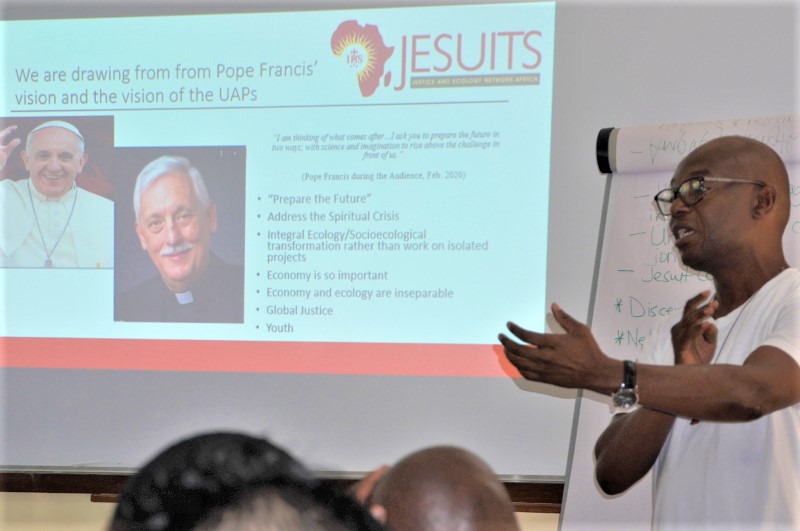
A recent seminar with Fr Rampeoane Hlobo SJ, the JCAM-Justice and Ecology Office, Director, opened our eyes and refocused our attention on the necessity and centrality of the Social Apostolate in the Society of Jesus, and on how its significance can be diminished when greater attention is given to other ministries, such as education and spirituality, without sufficiently integrating the social dimension of the Jesuit mission.
Jesuits are known globally for their immense contribution to education through their schools and colleges. For others, Jesuits are known for retreats and for guiding people in discernment through the Spiritual Exercises of St Ignatius of Loyola.
St Ignatius and the early Jesuits did not outline the Social Apostolate as a distinct sector of Jesuit ministry in the way we understand it today. Yet, the social dimension of the Jesuit vocation is already present in the Formula of the Institute. More explicitly, in the version approved by Julius III, one who desires to join the Society is challenged to “show himself ready to reconcile the estranged, compassionately assist and serve those who are in prisons or hospitals, and indeed to perform any other works of charity, according to what will seem expedient for the glory of God and the common good.”
Furthermore, in the Spiritual Exercises, paragraphs 101–109, the Contemplation on the Incarnation invites the exercitant to imagine the Trinity gazing down upon humanity and seeing the brokenness of the world, and then deciding to send the Son to intervene. The world was broken then, and continues to be broken even in our own day. It is from this backdrop that the Social Apostolate finds one of its roots: Jesuits are called to continue Christ’s mission of reconciliation in this same world, broken and wounded by structures of sin that have developed over time and throughout history.
In 1949, Fr Jean-Baptiste Janssens, then Superior General of the Society of Jesus, published the Instruction on the Social Apostolate, addressed to the whole Society. The document called for a new “social mentality” among Jesuits and urged the formation of Jesuits in social doctrine and the development of centres dedicated to social research and action. It became an important milestone in the development of the modern Social Apostolate.
The Social Apostolate seeks to promote justice, dignity and solidarity. It calls us not merely to respond to the effects of poverty and injustice, but also to examine and transform the structures that perpetuate them. In this sense, it calls us to move from structures of sin towards structures of grace.
However, it was Fr Pedro Arrupe SJ, the successor of Fr Janssens, who helped to give this vision a renewed place in the mission of the Society. During General Congregation 32, the Society was challenged to reconsider its mission in the contemporary world. This resulted in the famous Decree 4 of GC32, which defined the mission of the Society of Jesus today as “the service of faith, of which the promotion of justice is an absolute requirement.”
Later, General Congregation 34 further developed this understanding by speaking of the promotion of “that justice of the Gospel which is the embodiment of God’s love and saving mercy.”
Therefore, the Social Apostolate is not an optional extra. It should form part of every Jesuit ministry: in formation houses, schools and colleges, parishes, spirituality centres and other apostolic works. It cannot be limited only to social centres and organisations such as the Jesuit Refugee Service (JRS) and others. The Social Apostolate is better understood as an integral dimension of the one Jesuit mission, informing the way we carry out our different ministries.
This makes it crucial to include this dimension from the very foundation of our formation in the Novitiate and beyond. Solidarity with the poor and marginalised ought to be part of our daily reflection, our meditations and our contemplations. As Novices, it is imperative that we remain conscious of the plight of the excluded in the different apostolates in which we serve each week and in the experiments to which we are sent.
Such awareness can help us to readily recognise the suffering Christ in the many faces of those who are marginalised and in the structural peripheries of our communities. It can also teach us that our encounters with people who are poor, excluded or wounded are not simply “social work,” but opportunities to encounter Christ and to participate in his mission of reconciliation and justice.
This is closely connected to the second Universal Apostolic Preference of the Society of Jesus: to walk with the poor, the outcasts of the world and those whose dignity has been violated, in a mission of reconciliation and justice.
Perhaps, then, the challenge for us as Novices is not simply to learn about the Social Apostolate, but to allow its spirit to become part of who we are. If the Novitiate is preparing us for a lifetime of mission, then learning to see the world through the eyes of those who suffer, to listen to their stories and to recognise the structures that keep them on the margins must also become part of that preparation.
The Social Apostolate therefore calls us to remember that wherever a Jesuit is sent, there too is the call to seek justice, to accompany the excluded and to work for reconciliation. It is not a mission reserved for a few specialists. It is part of the mission we inherit as companions of Jesus.