
Pope Leo XIV’s Magnifica Humanitas: Safeguarding the Human Person in the Age of Artificial Intelligence

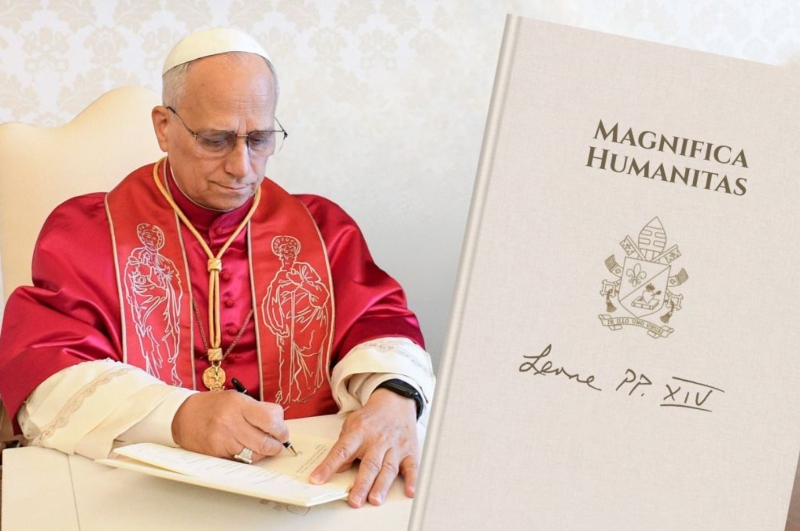


The encyclical argues that the Church’s social teaching and Christian humanism must guide how societies discern, regulate, and govern AI so that the dignity of every person is safeguarded.
The crisis behind the question: Babel or Jerusalem
Pope Leo XIV frames the present era as a decisive choice for humanity’s direction. Every generation “inherits the task of shaping its own era,” yet each era also risks producing “an inhumane and more unjust world.”
To interpret the moment, the Pope turns to two biblical “scenes” that reveal two competing logics. First is Babel: a project of human unity achieved through uniformity and technological control, conceived “without reference to God,” seeking stability and power through making a name. The result is not unity but dispersion communication breaks down when pride replaces communion and when persons are no longer understood in relation to God and one another.
Second is Nehemiah, whose city is in ruins after exile its walls collapsed and gates burned. Nehemiah responds not by imposing a top-down solution, but by fasting, praying, inspecting the damaged areas, and then rebuilding through shared responsibility: families, priests, artisans, heads of households, and young people all take part. In the Pope’s reading, Jerusalem is reborn through a common language of communion where each role is recognized and strength is understood as coming from the Lord, not from human self-assertion.
This is the interpretive key for AI. The Holy Spirit challenges today’s relationship with technology by asking whether AI will serve a “Babel” pattern profit-idolatry, dehumanizing uniformity, and reduction of the person to data or whether society will follow the “way of Nehemiah,” rebuilding a city of fraternal coexistence in which listening, dialogue, and shared responsibility make justice possible.
Technology is real power and never neutral
A central claim of the encyclical is that technology should not be treated as inherently antagonistic to humanity. The Pope notes that technological development can be deeply human and historically continuous technology can improve living conditions and, at its best, helps to “heal, connect, educate and protect our common home.”
Yet the same history reveals “ambiguity”: tools can cause harm when not oriented toward the good. Today, the difference is that emerging technologies are woven into daily life, reshaping decision-making and even the collective imagination. The Pope emphasizes that assessing long-term effects on dignity and the common good is increasingly difficult.
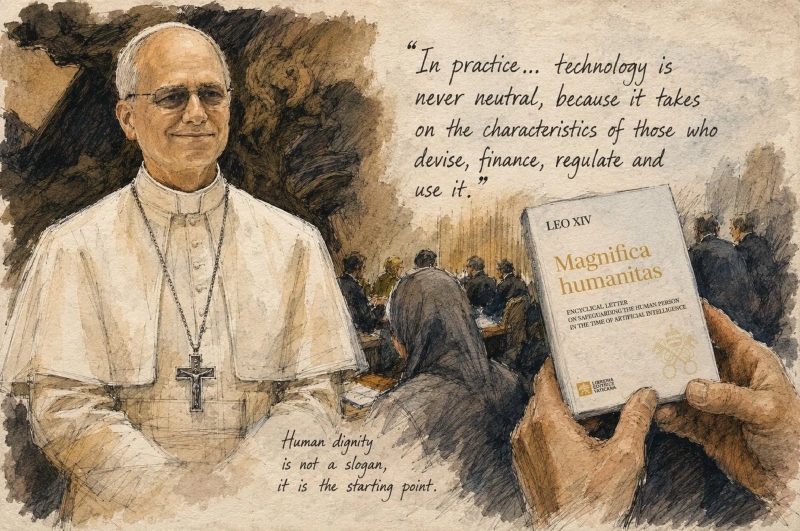
Therefore, the question is not simply “yes” or “no” to technology, but which moral logic governs it. “In practice,” the Pope writes, technology is never neutral because it takes on the characteristics of those who devise, finance, regulate, and use it. In other words: AI reflects the priorities, incentives, and worldviews of the actors who control it and can either enlarge human dignity or undermine it.
Governance, regulation, and the new geography of power
Pope Leo XIV insists that safeguarding persons requires more than good intentions. It is “necessary to establish adequate regulatory tools capable of upholding justice and curbing the distorting effects of technological power.”
But the encyclical also shifts the lens: regulation alone is not enough if societies do not ask who holds this power and how it is used. Historically, innovation was often guided by the State. Now, the encyclical states that “the main drivers of development are private, often transnational, parties” whose resources can exceed those of governments making governance more complex.
This sets up the Pope’s call for shared discernment. If societies focus only on immediate “contingencies,” emergency situations will dictate the path rather than guiding it. The encyclical describes a “change of era” in which many watch and hope for the best while crucial questions press on conscience: Where are we going? Toward what goal? What direction should we choose as a people and human community?
Dialogue and the Church’s social tradition
The Pope situates Magnifica Humanitas within a long Catholic engagement with social questions. He recalls that Pope Leo XIII’s Rerum Novarum responded realistically to concrete human life, refusing the idea that the Church should only speak of “eternal life” while ignoring social reality.
Pope Leo XIII’s Rerum Novarum, On Capital and Labour (1891) is the foundational moment for the Church’s “Social Doctrine,” and Pope Leo XIV explicitly frames his own project as rooted in that realism: in his encyclical, Leo XIII responded to concrete social turmoil rather than treating the Gospel as detached from everyday human life. In Magnifica Humanitas, Pope Leo XIV stresses that the Church’s social teaching offers “principles for thought… criteria for discernment… and concrete guidelines for action,” a living tradition that safeguards human vocation to “a full and just life.” It is not an inert set of concepts but a “living corpus of truth” oriented toward humanity’s “full and just life.” That is precisely the bridge from 1891 to our AI age: just as Rerum Novarum sought remedies for the “misery and wretchedness” endured by the working class, so Magnifica Humanitas calls for ordered governance and moral discernment so that new technologies do not become instruments of exploitation, dehumanization, or exclusion, but serve the common good.
To meet the challenges of AI, the Pope adds: the Social Doctrine must engage in dialogue with the men and women of the age, seeking “new paths for the common good and for promoting a dignified life for all.” He also presents dialogue as integral to the Church’s vocation, grounded in the Church as “a sacrament… of communion with God and of the unity of the entire human race,” and in the idea that history is where the Gospel challenges and directs human experience.
Building for the common good: God-centered humanism, not technical salvation
Pope Leo XIV proposes that “building for the common good” begins with a “firm relationship with God.” It involves recognizing that the truth of God’s love calls people to life “in all its fullness” and communion with him. In that sense, Christian humanism is not closed in on itself; it understands human longing as reaching toward God, echoing Augustine’s famous line that the heart is restless until it rests in God.
Second, building for the common good requires accepting human limits and weakness without treating them as mere errors to be eliminated. The Pope warns that the desire for fullness can be misled by “deceitful goals,” including technologies promising freedom from all weakness and “models of wellbeing” that leave entire populations behind. Instead, he insists that fulfillment is found through “harmonious growth,” where freedom and responsibility are intertwined with mutual care and solidarity and where progress is measured by each person’s dignity and the good of all peoples.
Third, flourishing requires shared responsibility and courage. No one can bear the world’s challenges alone, and no one is so weak that they cannot contribute. The encyclical explicitly invokes the logic of subsidiarity: scientists, entrepreneurs and workers, educators and legislators, civil society, popular movements, and faith communities each have their “own section of the wall.”
Fourth, building the common good requires an “evangelical language” clarity without humiliation, frankness without fearmongering. This is also practical: the Pope proposes standards for discernment human dignity, the universal destination of goods, the preferential option for the poor, care for our common home, and peace and recommends translating these into concrete practices.
Those practices include: responsible planning; assessment of human and social impact; inclusion of the most vulnerable; promotion of digital literacy; and guiding research and industry toward justice and peace.
The “Babel syndrome” in the technical guise of our time
Pope Leo XIV names the danger sharply. He argues for avoiding the “Babel syndrome,” which he describes as involving:
1. Idolatry of profit that sacrifices the weak,
2. A uniformity that neutralizes differences,
3. The pretense that a single (even digital) language can translate everything including the mystery of the person into data and performance.
In this way, the Pope connects an ancient temptation building without God and reducing others to instruments with a modern technical style. The risk is dehumanization: building a future that excludes God and reduces the other “to a means.”
Against that, he proposes choosing Nehemiah’s way: working together so that the “City of God” becomes a safe place for returning exiles, and allowing plurality of voices and visions though sometimes chaotic to become a resource through listening and dialogue.
A Christian “how”: from discernment to action
While Magnifica Humanitas is deeply theological in its framing incarnation, communion, the Holy Spirit, Christian anthropology it continually returns to action-guiding principles.
The Pope’s approach can be summarized as follows:
1. Discern the human goal (Where are we going? What direction should we choose?) before debating mere technological capability.
2. Regulate power because AI’s effects are shaped by those who control it and because justice must be upheld.
3. Reject reductionism that treats persons as data for performance rather than as persons with dignity.
4. Build through subsidiarity: shared responsibility across disciplines and social actors.
5. Translate values into governance and engineering via impact assessment, inclusion, literacy, and justice-oriented guidance for research and industry.
In conclusion, choosing communion over domination: At its heart, Magnifica Humanitas argues that AI is a powerful instrument but the moral direction of its use depends on whether societies choose Babel or Jerusalem. Babel names the temptation to build greatness through self-sufficiency, uniformity, and prideful control; Jerusalem names rebuilding relationships before stones, communion before domination.
If AI becomes a means of reducing people to performance, dehumanization follows. If, instead, AI is governed by standards of discernment dignity, the universal destination of goods, care for the poor, care for our common home, and peace and if it is shaped by shared responsibility and dialogue, it can serve integral human development.
Let us ask the Lord for the wisdom to guide this new power toward communion and justice, so that the grandeur of humanity created by God may be protected rather than compromised.
Encyclical Letter of His Holiness Pope Leo XIV, Magnifica Humanitas, On Safeguarding the Human Person in the Time of Artificial Intelligence.