
Magnifica Humanitas and the Christian task of safeguarding the human person in the age of AI

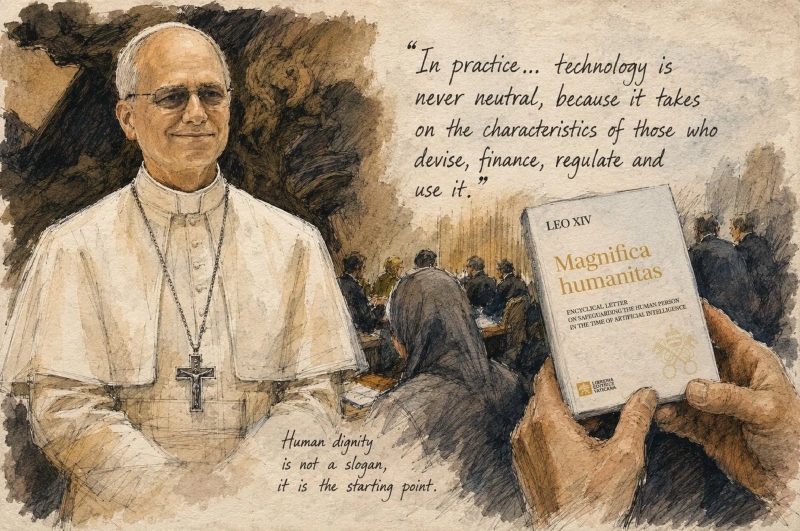


Read, together with Antiqua et Nova (Note on the Relationship Between Artificial Intelligence and Human Intelligence), the Church also insists on an essential clarification: AI can imitate intelligent behavior, but it does not possess human intelligence in the full sense. That distinction matters, because it shapes how society interprets reality, assigns responsibility, and safeguards human dignity.
Babel or Jerusalem: the spiritual choice behind technological change
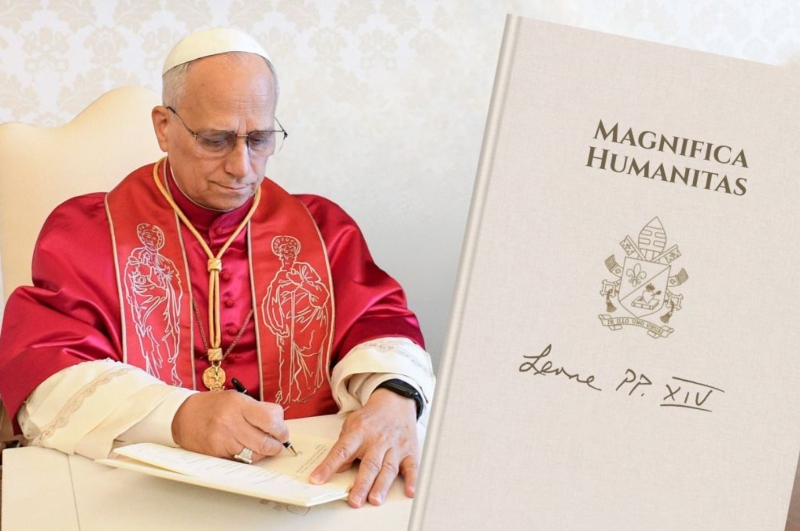
In the opening of Magnifica Humanitas, Pope Leo XIV presents the present moment as a pivotal choice for humanity. He frames it with two biblical images: either to construct a “new Tower of Babel” or to build the city “in which God and humanity dwell together.” This is not a call to fear progress, but an invitation to discern its direction. Every generation, the Pope says, inherits the task of shaping its era so that the dignity of each person is protected, justice is promoted, and fraternity becomes possible, while also acknowledging that every era can slide toward inhumanity and injustice. That spiritual framing is crucial. It means the Church reads AI through the lens of anthropology and morality: what kind of human society is being built? Where is God placed in the “project” of modernity? And what does it mean for human dignity to be safeguarded when decision-making processes are increasingly shaped by digital systems?
Progress that helps, tools that harm, and a new situation
Pope Leo XIV is careful not to treat technology as inherently hostile to humanity. He states that technology should not be considered, in itself, antagonistic to the human person; rather, it belongs to human history and is linked to human freedom. Over time, development has improved living conditions, but each phase of progress has also revealed technology’s ambiguity, how tools can cause harm when they are not oriented toward the good.
Then comes the encyclical’s distinctive note of seriousness: the present moment is “a new situation.” The Pope highlights that emerging technologies are woven into daily life, influencing how people decide and shaping the collective imagination. At the same time, the long-term effects of these changes, especially on personal dignity and the common good, are difficult to predict, because new technologies open horizons “imaginable but not yet fully predictable.” This leads to a moral demand for clarity, responsibility, and governance.
Regulation matters, but it is not the whole story
A straightforward response to technological risk is regulation, and Pope Leo XIV treats this as necessary. He teaches that it is “necessary to establish adequate regulatory tools” capable of upholding justice and curbing distortions produced by technological power.
But he immediately widens the question. The problem is not only “regulation” as a technical or bureaucratic task; it is also a question of power itself, who holds it and how it is used. Drawing on Pope Francis, the encyclical notes that the knowledge and especially the economic resources required to apply powerful technologies can give certain actors dominance over humanity and the entire world.
In the past, the State largely guided innovation, but today the Pope emphasizes that the “main drivers of development” are often private and frequently transnational, with resources and capacity that can exceed those of many governments. When technological power becomes predominantly private, the challenge of discerning, governing, and directing it toward the common good becomes more difficult.
Therefore, the encyclical calls for more than compliance mechanisms. It calls for a shared moral and cultural discernment.
Shared discernment of the spiritual and cultural roots of transformation
Pope Leo XIV insists that the path forward should begin with a “shared discernment process” aimed at identifying the spiritual and cultural roots of ongoing transformations. He warns that if attention remains focused only on immediate “contingencies,” the succession of emergencies can end up dictating the direction of history.
He situates this in a broader “change of era” in which some people strive for the future of new technologies while others reflect on them, but many others watch from a distance, observing, waiting, and hoping for the best. In that context, the encyclical argues that conscience cannot avoid crucial questions: “Where are we going?” and “Toward what goal do we…”,questions that are ultimately moral and spiritual, not merely technical.
This is where the Church’s anthropological reflection becomes decisive.
The meaning of “intelligence”: AI imitates, humans know
Antiqua et Nova supplies the clarification that many public debates skip: the Church distinguishes between AI’s concept of “intelligence” and human intelligence. It begins by grounding intelligence within the Christian vision of the human person, created in God’s image, and within humanity’s vocation to “till” and “keep” the earth. In that framework, intelligence is a gift expressed through responsible reason and technical ability in stewardship of creation.
The Note then explains why AI raises specifically anthropological and ethical issues. AI aims to imitate human intelligence, and it can generate new “artifacts” (like text or images) with remarkable speed and skill. Because AI can also adapt and make choices autonomously in ways not foreseen by programmers, it raises questions about ethical responsibility and human safety.
The most important point is definitional and philosophical: in AI, “intelligence” is understood functionally, often presumed to be decomposable into digitized steps that machines replicate. Human intelligence, by contrast, pertains to the person “in his or her entirety.”
The Note illustrates this difference with the Turing Test, where a machine is called “intelligent” if people cannot distinguish its behaviour from a human’s. But it argues that such a criterion focuses only on performance of specific tasks; it does not capture the full breadth of human experience, including emotions, creativity, and moral and religious sensibilities. In AI, intelligence is evaluated methodologically, and reductively, by output appropriateness, regardless of how those outputs are generated.
The Note states the conclusion plainly: AI’s advanced features enable sophisticated task performance, “but not the ability to think.” This is not a claim that AI is “useless”; it is a warning that societies must not confuse imitation with person-level knowing, nor output with moral responsibility.
Algorithms, truth, and the moral task of communication
Pope Leo XIV’s address to participants in the MINDS International Association Conference develops a related theme in the sphere of communication and public trust. He observes that, even amid a crisis of news and media, no one can say “I did not know,” because the information environment is saturated.
He describes information as a public good that must be protected, and he connects protection to serious attention to ethics, civic responsibility, and free access to accurate information. In that context he turns to algorithms and AI: “Algorithms generate content and data at a scale and speed never seen before. But who controls them?” He adds that AI is changing how people receive information and communicate, but asks who directs it and for what purposes.
This is a moral question about power and human agency: the Pope urges vigilance to ensure technology does not replace human beings, and that the information systems and algorithms that govern public life are not held by “a few.”
That urgency echoes the Church’s broader anthropology: humans are ordered toward truth and responsible judgment, while AI, however capable, operates differently. Where algorithmic systems dominate communication without transparency and accountability, the environment becomes unstable for moral discernment and the distinction between true and false becomes increasingly fragile.
The Church’s overall vision: safeguard the human person by restoring human-centered responsibility
Taken together, these documents offer a coherent Catholic approach. Magnifica Humanitas calls the world to choose not between a simplistic “yes” and “no” to technology, but between building a society that safeguards human dignity and fraternity, or sliding toward a Babel-like form of unity without communion. It acknowledges technological progress while insisting on justice, responsible governance, and attention to who holds power and how it is used. It also calls for shared discernment of the spiritual and cultural roots of digital transformation.
Antiqua et Nova supplies the key anthropological foundation: AI can imitate intellectual performance and generate persuasive outputs, but it does not “think,” and it cannot be treated as equivalent to human intelligence in the full philosophical and moral sense.
And Pope Leo XIV’s communication address shows how these principles become practical: societies must protect truth and free access to information, ensure transparency and accountability, and ask, again and again, who controls the algorithmic systems that shape public reality.
In conclusion, in the age of AI, Catholic teaching insists that the decisive question is moral and spiritual: whether technology will remain subordinated to human persons, persons who know, judge, love, and carry responsibility, or whether humanity will surrender its dignity, truth, and freedom to systems that can imitate intelligence without possessing it, and can govern society without transparent accountability.
Encyclical Letter of His Holiness Leo XIV Magnifica Humanitas (15 May 2026).
Address of Pope Leo XIV to Participants in the MINDS International Association Conference.
Credits: Banner Image: Missionary Sisters of Our Lady of Apostles (Editorial illustration created with the assistance of AI drawing on Creative Commons reference images of Pope Leo XIV).