
The Theological-Political Dimensions of Forced Displacement in Chad

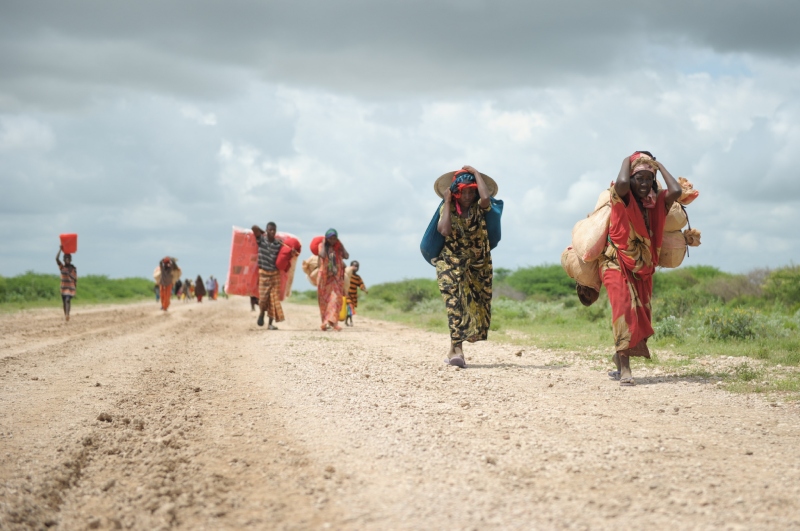


The violence ravaging her region of Sudan had forced her to abandon her home, her husband, who had disappeared during the fighting, and an entire life built over many years. Upon arriving at a refugee camp in eastern Chad, she quickly received a tent, food and medical care. Yet one suffering remained invisible: the nightmares, the constant fear and the pain of exile. Her story reminds us that forced displacement does not merely destroy homes; it also disrupts identities, social relationships and hope, and diminishes human dignity.
This reality challenges humanitarian actors, political leaders and ecclesial communities alike. According to the source article, Chad hosts more than one million refugees and asylum seekers, in addition to several hundred thousand internally displaced Chadians, mainly because of intercommunal conflicts and the effects of climate change. Furthermore, the article notes that Lake Chad has lost nearly 90% of its surface area since the 1960s, declining from approximately 25,000 km² to less than 2,500 km². This environmental degradation threatens the livelihoods of communities living around the lake and forces many Chadian families to move to other areas to survive.
Faced with these situations, one question becomes unavoidable: how should forced displacement be understood not only as a humanitarian crisis, but also as a theological-political issue that engages the responsibility of the Church, states and the international community? Our research seeks to clarify the responsibilities of the relevant institutions so that each may provide an appropriate response to alleviate the suffering of forcibly displaced migrants.
1. Forced Displacement: A Political Question Before It Is a Humanitarian One
Forced migration is never simply a geographical movement. It is very often caused by armed conflicts, oppression, persecution, violations of all kinds of human rights, or policies that deprive entire populations of security and a future.
For the philosopher Hannah Arendt, the condition of the refugee reveals a profound crisis in the modern political order. In The Origins of Totalitarianism, she demonstrates that displaced persons lose not only their territory, but also “the right to have rights”. Indeed, when the state is no longer able to ensure security and protect its citizens, they become particularly vulnerable to all forms of exclusion.
In Chad, migrants and internally displaced persons experience this vulnerability firsthand, aggravated by the economic limitations of the host country. Despite its remarkable tradition of hospitality, local communities themselves have limited resources to meet the needs of forcibly displaced people. Forced migration therefore becomes a matter of international justice and of shared responsibility among countries where humanitarian crises originate.
2. The Memory of Victims as a Theological Imperative
Political theology has a duty to shed essential light on this reality. For Johann Baptist Metz, Christian faith cannot forget the suffering of the victims of history. According to his theology, memoria passionis—that is, the memory of human suffering—is the basis of a fundamental dimension of Christian faith. In this sense, the stories of refugees are not merely testimonies; they become appeals addressed to the conscience of local and international societies.
From this perspective, telling Fatimé’s story is not merely an act of compassion. It is a way of resisting indifference and reminding local and international authorities that every displaced person possesses an irreducible dignity that must be protected. Political theology challenges the conscience of international actors involved in conflicts so that they assume responsibility for the consequences of their actions and give voice to the oppressed.
This approach is consistent with the reflection of Jacques Rancière, for whom politics begins when those who had been silenced speak and become visible in the public sphere. Thus, giving forcibly displaced migrants a voice means reintegrating them socially, restoring their dignity and recognizing their full humanity in a context of globalization in which the world is becoming a common home. This is why political theology takes upon itself the mission of making the voices of forcibly displaced migrants heard.
3. A Reading in the Light of the Church’s Social Teaching
The Church’s social teaching reminds us that every human person possesses before God an inalienable dignity that precedes any national or political belonging. As a human being, every person, whatever their social class or circumstances, possesses a dignity that must be respected. This conviction grounds the welcome of migrants as a requirement of justice rather than merely an act of charity.
For Gustavo Gutiérrez, the preferential option for the poor requires a transformation of the structures that produce exclusion. In other words, when we commit ourselves to struggling alongside forcibly displaced migrants to restore their human dignity, this also implies a commitment to transforming the social structures that are at the origin of human poverty and exclusion. Thus, refugees should not be regarded solely as beneficiaries of humanitarian assistance, but also as rights-bearing persons, called to participate fully in social life.
This perspective is strongly reaffirmed by Pope Francis when he calls societies to welcome, protect, promote and integrate. This invitation, characteristic of the Church’s social teaching, reminds us that authentic hospitality does not consist only in offering displaced persons temporary refuge, but also in accompanying them as they rebuild their lives. For the sake of integral hospitality towards migrants, Pope Francis invites us to move beyond logics of closure and build a universal fraternity founded on solidarity.
4. Towards Integral Hospitality
Following the vision of the encyclical Fratelli Tutti, the experience of the Jesuit Refugee Service (JRS) shows that this vision can become a concrete practice. By combining spiritual accompaniment, humanitarian assistance, psychosocial support and advocacy for rights, JRS contributes to restoring the dignity of displaced persons.Regarding the engagement of the Catholic Church in Chad, Basic Ecclesial Communities (BECs), parishes and Christian organizations also have an essential role to play. They can become spaces where refugees tell their stories, recover social bonds and rebuild hope.
At the same time, states and international organizations must strengthen policies for the protection of refugees. The Global Compact on Refugees recalls that responsibility towards displaced populations must be shared more equitably among nations. Chad cannot be expected to bear the burden of responsibility for forcibly displaced persons alone. This solidarity includes sustainable financing for humanitarian programmes, as well as mental-health, education and socio-economic integration initiatives supported by the international community.
Making the Voices of Migrants Heard: Fatimé’s story reminds us that no refugee can be reduced to a statistic. Behind every migrant lies a wounded memory, a separated family and a hope that calls to be restored. The JCAM Migration Newsletter responds precisely to this need by providing a platform where migrants can tell their stories, contribute to public dialogue and promote more dignified, safer and more inclusive human mobility.
Giving displaced persons a voice is not merely an exercise in memory; it is a theological, political and prophetic act. It is to recognize that their experience sheds light on the challenges of our time and calls societies to build an integral hospitality founded on justice, solidarity and the dignity of every human person.
About Author: Kladoum Madjikoumna Rodolphe, a Jesuit Scholastic studying Theology at Institute De Théologie de la Compagnie de Jésus, Abidjan


